Yellow Faced Bees ~ Hylaeus spp.
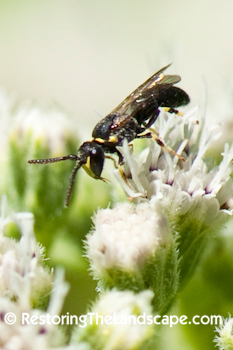
Yellow Faced Bees are tiny black bees with yellow (sometimes white) markings on their face, thorax and legs. Often mistaken for tiny solitary wasps, these bees have quite shiny bodies due to the lack of hairs.
Occurring from late May through to September, we will see Yellow Faced Bees in early spring, then again in late summer with a gap in between.
Some of the first native plants to look for Yellow Faced Bees in spring are Golden Alexanders (Zizia spp.). This female is feeding on pollen of Golden Alexander. Yellow Faced Bees are different from other native bees because they collect pollen and nectar in their crop. They have no pollen-collecting combs on their legs or abdomens.
Pollen is brushed with their forelegs from their head and thorax and then collected in the mouth.
Females collect pollen and nectar, and regurgitate the liquid mixture to provision the brood cells. An egg is laid on top of the mixture where the larva will hatch and consume the liquid.
Yellow Faced Bees nest in cavities, tunnels in pithy wood, or even holes in wood. Their brood cells are separated with a cellophane like material.
A Yellow Faced Bee visiting Canada Anemone (Anemone canadensis) for pollen in early spring.
In late summer look for Yellow Faced Bees nectaring on Swamp Milkweed (Asclepias incarnata). I had several dozen visiting just one plant this summer.
Although Yellow Faced Bees are short-tongued, their small size allows them access to the nectar of many flowers.
They also visit Common Boneset (Eupatorium perfoliatum) in late summer.
Source: Attracting Native Pollinators: The Xerces Society Guide, Protecting North America's Bees and Butterflies
Pollinators | Beneficial Insects | Landscape Restoration | Native Plants | Wildlife |
Native Bee Spotlight: Leafcutter Bees ~ Megachile spp.
Leafcutter Bees are a medium sized, long-tongued native bee. They have a flattened or deflated looking abdomen, and often visit flowers with their abdomen curved upwards.
We start to see Leafcutter Bees in our landscape in early June. Some of the first native plants they visit are Harebell and Pale Purple Coneflowers.
Instead of collecting pollen on combs on their legs, females collect pollen on the underside of their abdomen where they have long hairs.
A female nectars on Nodding Onion (Allium cernuum) showing off her pollen-laden belly.
If you don't see Leafcutter Bees on your native plants, look for circular or oval shaped cuts in the foliage like this.
Females use their sharp mandibles to cut pieces of leaves from foliage. I captured this female cutting an oval-shaped piece of leaf from our Great St. John's Wort (Hypericum pyramidatum) this summer. Leafcutter Bees use these pieces of leaves to line their brood cells where they build nest in pre-existing cavities such as in wood or hollow stems.
Look for Leafcutter Bee females collecting pollen and nectar from a wide variety of prairie plants such as this Gray Headed Coneflower (Ratibida pinnata).
Also feeding on nectar on Wild Bergamot in July. This Leafcutter Bee is taking advantage of a short cut created by a wasp. The wasp chewed a hole near the base of the tubular flower to get easy access to the nectar (nectar thievery).
Leafcutter Bee on Fragrant Hyssop (Agastache foeniculum), a licorice (anise-scented) prairie native.
In moister locations, Leafcutter Bees will visit Culver's Root (Veronicastrum virginicum).
Also Cup Plant (Silphium perfoliatum) in late summer.
Source: Attracting Native Pollinators: The Xerces Society Guide, Protecting North America's Bees and Butterflies
Ohio Spiderwort Insect Visitors
Ohio Spiderwort ~ Tradescantia ohiensis
Ohio Spiderwort flowers open in the mornings for insect visitors, then close up during the heat of the day. The attractive blue to purple flowers have a fuzzy appearance due to the fine hairs on the filaments. Spiderwort flowers from late April through to July.
Bees are the primary visitor, for the abundant pollen in particular. Bumble Bees such as Bombus bimaculatus pictured here collect pollen to provision their nests.
Another common spring occurring bee is the Mason Bee (Osmia sp.), their hairy, blue metallic bodies make them fairly easy to identify.
Mason Bees build nests in cavities, they are the primary nester in bee boards in our area.
Small Carpenter Bees (Ceratina sp.) feed on the pollen of Ohio Spiderwort. They nest in hollow or pithy stems.
A great reason to leave dead, pithy branches such as Elderberry in your landscape to provide nesting habitat for this small bee.
Small Sweat Bees (Lasioglossum sp.) also like the pollen of Ohio Spiderwort. We have a lot of Small Sweat Bees in our landscape, probably because our soils are sandy which is where this ground nesting bee likes to excavate its nests.
Larger Sweat Bees such as this Green Sweat Bee (Agapostemon sp.) are brightly colored and hard to miss. They also nest in the ground.
These are one of the more difficult bee species to photograph, they're fast-moving and not as willing to stay in one place for very long.
The one type of bee that doesn't visit Ohio Spiderwort flowers for pollen is the European Wool Carder Bee (Anthidium manicatum). An introduced species from Europe, females like to visit Ohio Spiderwort for the fine hairs on the buds and flower stalks. Females chew the hairs with their sharp mouthparts, and use the 'wool' to make brood cells.
Syrphid Flies of many types will visit flowers and feed on pollen.
Also look for Bee Flies investigating the flowers.
And where there are bees, there are predators about such as this crab spider, legs outstretched waiting for the unsuspecting bee to stop by.
Ohio Spiderwort is a very adaptable prairie native of medium to dry soils, in full to part sun. It's a great early spring source of pollen for our native pollinators.
Ohio Spiderwort flowers open in the mornings for insect visitors, then close up during the heat of the day. The attractive blue to purple flowers have a fuzzy appearance due to the fine hairs on the filaments. Spiderwort flowers from late April through to July.
Bees are the primary visitor, for the abundant pollen in particular. Bumble Bees such as Bombus bimaculatus pictured here collect pollen to provision their nests.
Another common spring occurring bee is the Mason Bee (Osmia sp.), their hairy, blue metallic bodies make them fairly easy to identify.
Mason Bees build nests in cavities, they are the primary nester in bee boards in our area.
Small Carpenter Bees (Ceratina sp.) feed on the pollen of Ohio Spiderwort. They nest in hollow or pithy stems.
A great reason to leave dead, pithy branches such as Elderberry in your landscape to provide nesting habitat for this small bee.
Small Sweat Bees (Lasioglossum sp.) also like the pollen of Ohio Spiderwort. We have a lot of Small Sweat Bees in our landscape, probably because our soils are sandy which is where this ground nesting bee likes to excavate its nests.
Larger Sweat Bees such as this Green Sweat Bee (Agapostemon sp.) are brightly colored and hard to miss. They also nest in the ground.
These are one of the more difficult bee species to photograph, they're fast-moving and not as willing to stay in one place for very long.
The one type of bee that doesn't visit Ohio Spiderwort flowers for pollen is the European Wool Carder Bee (Anthidium manicatum). An introduced species from Europe, females like to visit Ohio Spiderwort for the fine hairs on the buds and flower stalks. Females chew the hairs with their sharp mouthparts, and use the 'wool' to make brood cells.
Syrphid Flies of many types will visit flowers and feed on pollen.
Also look for Bee Flies investigating the flowers.
And where there are bees, there are predators about such as this crab spider, legs outstretched waiting for the unsuspecting bee to stop by.
Ohio Spiderwort is a very adaptable prairie native of medium to dry soils, in full to part sun. It's a great early spring source of pollen for our native pollinators.
Long-Styled Sweet Cicely Insect Visitors
Long-Styled Sweet Cicely is one of my favorite woodland native plants. Its other common name is Aniseroot for its licorice-scented roots. Flowering in May, it's an attractive, medium sized, shade-tolerant perennial with tiny, five-parted white flowers arranged in an umbel. Another common Cicely is Sweet Cicely, Osmorhiza claytonii.
Unlike some other spring flowering woodland natives such as Bloodroot or Rue Anemone, Cicely offers both nectar and pollen rewards to visiting insects.
Cellophane Bees (Colletes spp.) visit the flowers for nectar, but in the process their hairy faces get covered with the white pollen which will aid in cross-pollination.
Cicely was the first plant I noticed this Syrphid Fly visiting (Sphegina spp.). These flies are common visitors to woodland natives in early spring, and they seem to have a preference for white flowers. They feed on both nectar and pollen of Long-Styled Sweet Cicely.
They resemble a thread-waisted wasp, with narrowed waists, and an over-sized rear femur. Larvae develop in water-logged wood as well as under wet bark. Look for these Syrphid Flies on Bishop’s Cap, Tall Meadowrue, Marsh Marigold and Goat’s Beard in the spring.
Small Sweat Bees (Lasioglossum spp.) visit Cicely flowers for both nectar and pollen. Nectar is easily accessible for short-tongued bees as the tiny flowers are shallow.
Cicely also attracts beneficial insects like this Tachinid Fly, possibly a Siphona spp. Tachinid Flies lap up nectar with their sponge-like mouthparts. Adults lay eggs near or on their prey, primarily caterpillars, and the hatching larvae feed on their hosts.
I have also seen some day-flying moths visiting Cicely flowers for nectar, but did not get a photo.
Cicely foliage stays attractive throughout the summer months in the landscape but it does produce seeds with fine hairs that stick to animal fur and clothing.
If you have a shady to part sun location with average soils, Cicely is an excellent candidate.
Wild Lupine Insect Visitors
Wild Lupine ~ Lupinus perennis
Wild Lupine is a native perennial of dry, sandy sites in full sun. Flowering from late April/early May into June, the flower color ranges from light blue to dark purple.
Because of its early flowering time, overwintering queen Bumble Bees or their female offspring will visit the flowers. The irregular flower form means that the larger Bumble Bees don't have too much difficulty prying open the lower wing petals to reveal the reward inside.
According to Illinois Wildflowers, there is no nectar reward provided by Wild Lupine, and pollen is forcibly ejected into the faces of bees.
Butterflies and moths will visit the flowers looking for nectar but come away with no reward. I photographed this Hummingbird Clearwing Moth this spring on our Wild Lupine flowers.
I also observed many Mason Bees (Osmia spp.) visiting Wild Lupine flowers this spring. They start with their rear legs prying open the petals, get a start on it opening, then use their mid and forelegs to hold the flowers open.
Wild Lupine and Mason Bees were built for each other, as Mason Bees collect pollen on their abdomens. Perfect for where the fused stamens are located just above the bottom keel, rubbing off some pollen for cross-pollination onto the Mason Bee abdomen.
Look for Mining Bees (Andrena spp.) a ground nesting native bee that emerges in early spring and visits flowers to collect pollen and nectar for nest provisioning.
Small Carpenter Bees (Ceratina spp.) also look in vain for nectar on flowers that have been forced open and are accessible as they cannot pry open the petals themselves.
Wild Lupine is a larval host plant to several butterfly and moth species, the most notable is the specialist Karner Blue Butterfly (Lycaeides melissa) an endangered butterfly.
Wild Lupine is a native perennial of dry, sandy sites in full sun. Flowering from late April/early May into June, the flower color ranges from light blue to dark purple.
Because of its early flowering time, overwintering queen Bumble Bees or their female offspring will visit the flowers. The irregular flower form means that the larger Bumble Bees don't have too much difficulty prying open the lower wing petals to reveal the reward inside.
![]() |
| Bombus auricomis |
According to Illinois Wildflowers, there is no nectar reward provided by Wild Lupine, and pollen is forcibly ejected into the faces of bees.
I also observed many Mason Bees (Osmia spp.) visiting Wild Lupine flowers this spring. They start with their rear legs prying open the petals, get a start on it opening, then use their mid and forelegs to hold the flowers open.
Wild Lupine and Mason Bees were built for each other, as Mason Bees collect pollen on their abdomens. Perfect for where the fused stamens are located just above the bottom keel, rubbing off some pollen for cross-pollination onto the Mason Bee abdomen.
Look for Mining Bees (Andrena spp.) a ground nesting native bee that emerges in early spring and visits flowers to collect pollen and nectar for nest provisioning.
Small Carpenter Bees (Ceratina spp.) also look in vain for nectar on flowers that have been forced open and are accessible as they cannot pry open the petals themselves.
Wild Lupine is a larval host plant to several butterfly and moth species, the most notable is the specialist Karner Blue Butterfly (Lycaeides melissa) an endangered butterfly.
Subscribe to:
Posts (Atom)


