Red-Headed Woodpecker ~ Melanerpes erythrocephalus

Red-Headed Woodpecker ~ Melanerpes erythrocephalus


We were thrilled to have an adult Red-Headed Woodpecker visit our yard in mid-May of 2010. If you've ever seen one of these woodpeckers, they have eye catching tri-colored plumage of red, white and black. It's the only woodpecker in North America to have a solid red head (when mature).

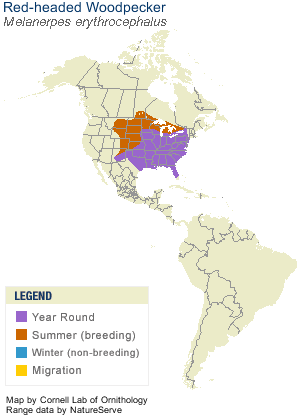
Red-Headed Woodpecker range includes Montana east to New York, south to Texas and Florida (see map at bottom).


We excitedly told friends about our sighting, most thought we were talking about the more common Red-Bellied Woodpecker which have red on their heads. They are named for the red patch on their lower front.
(Left Photo: Female Red-Bellied Woodpecker)

Red-Headed Woodpecker populations are on a serious decline. "[P]opulations have declined 89% since 1967. The bird has experienced an average decline of 4.6% per year since 1980 due to loss of habitat and other factors." (Red-Headed Woodpecker Recovery Website)


Red-Headed Woodpeckers like open woodland habitats with mature live trees (primarily nut producing trees) and plenty of snags (dead standing trees) for cavity nesting. They also prefer an open understory. Locally, our oak woodland-brushland and oak savannas are ideal habitats except there is usually not enough snags available for nesting cavities.

"Red-heads are primary cavity excavators. They create tree holes for nesting, food storage and roosting. Once abandoned, these cavities become sites for secondary cavity nesters, birds that will not create their own holes but depend on holes left by others. These species include bluebirds, swallows, wrens, flycatchers, kestrels, screech-owls as well as others." (Red-Headed Woodpecker Recovery Website)

"They [b]egin nest-building as early as February and egg-laying as early as mid-April. An average of 4-7 eggs are laid in the cavity and incubated by both parents for 12-14 days. May have two broods per season and will lay a second clutch if first fails. A pair may use the same cavity for several years in a row." (Audubon Website)

Juvenile Red-Headed Woodpeckers have brown heads and black stripes in their white wing patch.


Red-Headed Woodpeckers "consume seeds, nuts, sap, corn, fruit, insects, bird eggs, nestlings, adult birds, and mice. Eats mostly insects and plant material in summer and mostly nuts (acorns and beechnuts) in winter. Will forage on ground, capture insects in flight, glean food from vegetation, or chisel trees for wood-boring insects and sap. Most adapted of all the woodpeckers for flycatching. Will store food for winter (grasshoppers, nuts, corn, and fruit) in natural crevices of trees and posts, in tree cavities, under bark, and under railroad ties and shingles. Only known woodpecker to cover stored food with bark or wood." (Audubon Website)

Image Source:
Cornell Lab of Ornithology
Municipalities and private landowners who live in the Red-Headed Woodpecker range can make a difference by leaving dead trees standing, maintaining a lower density or more open spacing of trees, keeping an open understory, and a good number of nut producing mast trees. (Red-Headed Woodpecker Recovery Website)

An sightings can be reported at the Red-Headed Recovery website.

More Information
Red-Headed Woodpecker Recovery
Audubon
Cornell Lab of Ornithology


Native Plant of the Week: Michigan Lily ~ Lilium michiganense

Michigan Lily ~ Lilium michiganense


If you want a show stopping native alternative to asiatic lilies, then check out the beautiful Michigan Lily.

The bright orange flowers are speckled with brown spots. Over 3 inches wide, the large buds and flowers hang downwards from a long stem.


Flowers open in early July, as the six tepals unfurl they curve backwards upon themselves.

Michigan Lilies are found in moist locations, along riparian areas and wetland edges. Be sure to plant your bulbs/plants in a mesic to moist location in part or full sun.

The leaves are equally interesting, arranged in whorls on the stem, then becoming alternate at the top near the flowers. We have Michigan Lilies planted just inside our gate and they grow well above our picket fence.

Michigan Lilies are native to northeastern North America. See map below for range.
Kartesz, J.T., The Biota of North America Program (BONAP).
2011. 
North American Plant Atlas. Chapel Hill, N.C.

Design and Construction of a Thriving Pond Habitat

One of my blog followers, Mark Funk emailed me in December. In our email conversation I learned about his amazing pond design and construction and wanted to share his project with you.

Here's Mark's story in his own words:

As a university student who had become obsessed with native plants, I was thrilled to hear my parents say that they would like to put a native pond garden in our front yard last year. I had been entertaining the idea of a career in natural landscaping, so our yard became the perfect stage for me to practise and hone my skills. Being my first real venture into natural landscaping, the pond was an experiment and a learning experience.

My parents’ home sits on a vineyard in the Niagara Region in southern Ontario’s Carolinian Zone – known for its natural, but imperiled, diversity. Our goal was to create a beautiful pond that we could enjoy along with others, while contributing to the ecological communities of southern Ontario. I decided that the best way to do this was to mimic the patterns and associations that can be observed in nature.

A landscape architect friend of mine, Mattson Meere, designed the pond shape for us, as well as the surrounding garden shape, complete with armour stone retaining wall and berms. The pond is an irregular shape, somewhat triangular, and approximately 10 metres (33 feet) at the widest point and 12 metres (39 feet) at the longest. It is about 1.5 metres (five feet) deep in the middle with a 70-centimetre (28-inch) deep shelf that runs around the perimeter.
Illustration by Mark Funk
After having the pond excavated in spring of 2010, we installed a liner to ensure that the pond would have adequate water levels year-round. Then we added soil on top of the shelf for planting aquatic species. We left the bottom section of the pond without soil to prevent vegetation from growing there. This will help to maintain an area of open water in the centre of the pond where the vegetation won’t encroach.

Once the pond was excavated, liner installed, and soil added, it was time to do the planting. My family and I planted over 500 plugs and pots over two hot July days, which tested our dedication, but ultimately proved very rewarding. Despite the fact that we completed the planting just before a two-week hot spell with no rain, most of the plants flourished with only a few good waterings. Of course, the plants that were planted into the water or moist soil around the pond were not as susceptible to drought, but the upland plants around the perimeter didn’t seem to be bothered much either!

The plants that did the worst were the shade-loving species that I shouldn’t have planted into full sun conditions in the first place, such as wild ginger (Asarum canadensis), Jack-in-the-pulpit (Arisaema triphyllum) and bloodroot (Sanguinaria canadensis). Some of these species wilted and appeared to have died within a week of planting, but to my surprise, sprouted again this spring. Adding a heavy layer of ‘forest mulch’ (a combination of shredded wood and bark chips) to the garden helped to suppress weeds and retain soil moisture.

The pond is bordered by a variety of plants from a number of native plant communities. I selected an array of wetland plants for the moist areas, and then a mix of prairie, meadow and forest plants for the surrounding garden, which includes a full spectrum of sun conditions. In total, over 55 species of plants native to southern Ontario were planted.

Cardinal Flower
Wetland plants incorporated include great blue lobelia (Lobelia siphilitica), cardinal flower (Lobelia cardinalis), fringed sedge (Carex crinita), sweet flag (Acorus americanus), pickerelweed (Pontederia cordata), fox sedge (Carex vulpinoidea), swamp milkweed (Asclepias incarnata), soft rush (Juncus effesus), ironweed (Vernonia missurica), marsh marigold (Caltha palustris), sensitive fern (Onoclea sensibilis) and arrowhead (Sagittaria latifolia).


White Snakeroot
On the upland soils we planted big bluestem (Andropogon gerardii), little bluestem (Schizachyrium scoparium), switchgrass (Panicum virgatum), Indian grass (Sorghastrum nutans), butterfly milkweed (Asclepias tuberosa), black-eyed Susan (Rudbeckia hirta), red osier dogwood (Cornus sericea), Canada anemone (Anemone canadensis), white snakeroot (Eupatorium rugosum), sky blue aster (Aster oolentangiensis), wild columbine (Aquilegia canadensis), woodland sunflower (Helianthus divaricatus), New Jersey tea (Ceanothus americanus), wild bergamot (Monarda fistulosa), wild geranium (Geranium maculatum), green-headed coneflower (Rudbeckia laciniata) and many others.

Swamp Milkweed
One of my goals for the project was to make the pond garden a landscape feature that could interact with, and improve, the integrity of local plant communities. For this reason, I planted many of the species that can be found growing in the small fragment of forest and swamp across the road from our house. After we planted the pond, I found it rewarding to discover local populations of the species I had planted, such as blue vervain (Verbena hastata), blue flag iris (Iris versicolor), swamp milkweed and alternate-leaved dogwood (Cornus alternifolia), all within a couple of kilometres of our pond!

Although the project’s total cost was about $5,000 (CDN), the Niagara Peninsula Conservation Authority (NPCA) funded $1,500 through their Water Quality/Habitat Improvement Project, covering 75% of the plant material costs. The NPCA provides grant assistance for a variety of rural and urban stewardship activities taken on by landowners. We could have cut costs by not using a rubber liner, which cost $1,500, and by reducing the amount of mulch we applied. We’re happy with the design and materials we used, but there is no reason a native plant garden cannot be created for far cheaper. Had we used traditional pond landscaping methods, such as exotic plants typical of the horticultural industry or an ornamental fountain, there’s no doubt in my mind the price tag on the project would have been significantly higher.

The wildlife that has already appeared in our ecologically isolated yard is incredible! American toads, green frogs and leopard frogs all arrived within a month of the pond’s installation, and in significant numbers too! Along with the frogs and toads came boatmen, water-striders, dragonflies, butterflies, increased bird activity and a great blue heron sighting at the pond’s edge.

In Year Two we welcomed the addition of a painted turtle, which had wandered onto our yard, and two largemouth bass, which I brought in from a friend’s nearby pond. In addition to the new fauna on our property, species of flora that were not planted by us have found their way into our mini-ecosystem, such as nodding bur marigold (Bidens cernua) and cattails (Typha sp.). This tells me that our yard is already interacting with the local environment as seed dispersal and exchange occurs.

High nutrient levels in the topsoil we added into the pond during construction resulted in an algal bloom at the end of the pond’s first summer. Manual removal of the algae with a pool skimmer seemed the best way to control it. I’ve been told that a pond often needs two to three years for its water chemistry to balance. Shading from aquatic plants can also help control algae by lowering the water temperature. The algae have not been an issue so far in the second year.

The plants are flourishing, filling bare ground as individuals grow bigger and seeds spread. We’ve added logs to the woodland section of the garden by salvaging pieces of fallen trees nearby and we continue to record wildlife species that come to visit.

In addition to the aesthetic and ecological value we derive from the pond, we have also used it for swimming in the summer (despite having a backyard pool) and ice hockey in the winter, making it a multi-season recreational opportunity.

By putting it in the front yard we are voluntarily enduring the scrutiny of every passer-by. It’s rare that we see a car drive by without the driver doing a double take! I enjoy the social and environmental statement the pond makes. It says that we are willing to step outside of societal norms to improve habitat and biodiversity on our property. Many people have taken notice of that, and we have received lots of positive feedback and interest. But ultimately, the reward is seeing the beauty and functionality of the pond as its plants put on their stunning displays and the fauna begin to return to our yard.

Mark Funk recently completed an environmental studies degree at the University of Waterloo, Waterloo, Ontario and is currently studying landscape design in order to pursue his ecological restoration interests.

Native Plant of the Week: Hoary Puccoon ~ Lithospermum canescens

Hoary Puccoon ~ Lithospermum canescens


The bright orange flowers of Hoary Puccoon are a treat to see in full bloom in May. A tough native perennial of mesic to dry sites, it is most commonly found in full sun in dry prairies or woodland edges.

It is notoriously very difficult to grow from seed, if at all. Lithospermum is Greek for lithos (stone) and sperma (seed), for its extremely hard seed coat. Transplant success is also low due to its tap root.

Blooming in early to mid May, the five parted tubular flowers are arranged in cymes that curve over as they open.

The leaves are arranged alternately and are covered in fine white hairs giving it a hoary or gray appearance. Hoary Puccoon grows between 4" and 15" in height, depending upon soil moisture.
"Hoary Puccoon is very similar to Carolina Puccoon (Lithospermum caroliniense). Carolina Puccoon has 1-inch flowers, the bracts are much longer, and the stem hairs are shorter, more sparse, and more bristly." (Minnesota Wildflowers)

Hoary Puccoon is native to the midwest and eastern North America. See map below for range.


Kartesz, J.T., The Biota of North America Program (BONAP).
2011. 
North American Plant Atlas. Chapel Hill, N.C.


High Bush Cranberry Viburnums - Native or Not?

My post today at Native Plant Wildlife Gardens is about European vs American High Bush Cranberry Viburnum.

Native Plant of the Week: Pale Corydalis ~ Corydalis sempervirens

Pale Corydalis (Rock Harlequin) ~ Corydalis sempervirens

Pale Corydalis is a very attractive biennial native. I saw a large cluster of these growing this spring in late May in central Ontario. Growing in shallow soils on top of the Canadian shield granite bedrock, most plants reached heights close to 3 feet tall.

Pale Corydalis is in the Fumitory family (Fumariaceae) along with other great natives - Dutchman's Breeches (Dicentra cucullaria) and a beautiful biennial vine Climbing Fumitory, (Adlumia fungosa). Fumitory plants have interesting four parted flowers, often fused into a tube or spurred.

The flowers of Pale Corydalis have one spurred petal, and are bright pink with yellow tips. They are arranged in showy clusters above the light blue-green foliage.
The leaves are pinnately divided with smooth edges. Since this is a biennial, first year plants are basal rosettes, and in the second year the plant flowers.

You will find this native in partial and full sun locations, most often in shallow, dry soils. It is native to northeastern North America. See map below for range.

Image Source: USDA Plants Database


Native Plant of the Week: Blue Cohosh ~ Caulophyllum thalictroides

Blue Cohosh ~ Caulophyllum thalictroides


Blue Cohosh is a wonderful, delicate, spring flowering woodland native perennial. It is somewhat under appreciated because the flowers aren't particularly showy. It does have other note worthy attributes that make it an excellent addition to any shady, mesic site.

Blue Cohosh usually occurs in small groupings in the shade of deciduous trees on upland sites. The small terminal clusters of 6 parted, yellow-green flowers emerge in mid May and arise above the blue green foliage. The flower and leaf stalks have a light blue to purple coloration which is quite unique.

The leaves are large and three parted, which are again divided into 3 lobes. As the species name suggests (thalictroides), the foliage is similar in appearance to Meadow Rue (Thalictrum).

Blue Cohosh is quite tall for early flowering ephemerals, reaching heights of 3 feet in moister sites. It stands upright and remains sturdy throughout the summer months. For this reason, it works well massed in a woodland garden and the texture of the foliage contrasts nicely with ferns and later flowering woodland species.
The stalked blueberry like fruit develop by late August and mature from a light green to dark blue purple. They look like a fleshy berry but in fact its a hard seed coat covered by a blue skin.

I have had some success propagating Blue Cohosh, the hard seed coat definitely needs to be scarified before planting. Young seedlings take a while to establish.

Blue Cohosh is native to eastern North America, see map below for range.
Kartesz, J.T., The Biota of North America Program (BONAP).
2011. 
North American Plant Atlas. Chapel Hill, N.C.


Anise Scented Hyssop ~ Agastache foeniculum

Guest post by Michael Lynch

Anise Scented Hyssop, Purple Giant Hyssop
 ~ Agastache foeniculum

Anise Hyssop is one of the few beautiful native wildflowers that we in the frozen north can call our own. It is native from essentially the Twin Cities, North and west through North Dakota and Montana with only a few scattered areas elsewhere. From what I hear, it grows successfully much further south.

In the garden, Hyssop has a lot going for it. It has attractive blue flowers that are a magnet for bees and butterflies. Its flower heads retain purplish color even after they are done blooming, and it reblooms throughout the summer starting in June.

Anise Hyssop is quite easy to grow sometimes it becomes a little too easy. It prefers full sun however still looks quite attractive under part shade. It is a perennial plant, but it can usually bloom it's first year from seed. It has been known to be weedy in the garden and I dead head mine so that it won't reseed too heavily.

A notable characteristic of this species is its scent. If you brush your hand over a flower head you will notice a distinct scent of anise. If you like anise, you can use it to make teas or drinks. If you love anise you will plant it near a side walk so you can pick a leaf and taste it. If you really love anise, you can plant Hyssop in your herb and vegetable garden for browsing purposes.


I keep a few plants in my vegetable garden so that whenever I go out, I can pick the tenderest young leaves from the tips and eat them while I tend the garden. When the leaves are mature, the flavor is too strong and rather bitter.