Native Plant of the Week: Heart-Leaved Aster ~ Symphyotrichum cordifolium

Heart-Leaved Aster ~ Symphyotrichum cordifolium (Aster cordifolius)

Heart-Leaved Aster is a very versatile native perennial. It can withstand well drained, dry soils in partial shade as well as full sun. One of the earlier flowering Asters, it is an important fall plant for pollinators preparing to overwinter.

As the common name suggests, the leaves are heart shaped with a short stalk.

Flower color can range from a pale blue-white to medium blue-purple. It is a tall native reaching heights of 4 feet in richer, moister soils.
The flowers are arranged in branched clusters, forming a slightly cone-shaped flowerhead.

You will find Heart-Leaved Aster in woodland openings or partially shaded understories, as well as in dry, sunny open sites. It will reseed heavily if planted in rich soils.

It is an excellent native perennial to utilize in woodlands after removing an understory of invasive European Buckthorn. It helps keep out other invasive species such as Garlic Mustard from encroaching into the void.

Fall emerging Mining Bees (Andrena spp.) love to visit the flowers, along with Bumble Bees.

Heart-Leaved Aster is native to eastern North America, see map below for range.
Kartesz, J.T., The Biota of North America Program (BONAP).
2011. 
North American Plant Atlas. Chapel Hill, N.C.


Another Native Cuckoo Bee

As you build a healthy landscape with native plants and create and foster wildlife habitat,  you are building a food web which will ultimately attract top tier predators. Top tier predators such as hawks need good nesting habitat as well as an ample food source to feed their young. The same is true for insects. Many insects predate on other insects, so they need their prey to be present as a food source and sometimes for rearing young.

There are many types of cleptoparasitic (Cuckoo) native bees - bees that don't collect pollen and build nests, but instead lay their eggs in the nests of other bee species. The host species' larvae is usually killed leaving the bee bread (pollen and nectar ball) for the Cuckoo Bee to eat as it develops.

The Cuckoo Bee, Triepeolus spp. is a bee that lays eggs in the nests of Long Horned Bees, Melissodes spp. This was the first year that I observed this type of Cuckoo Bee in our landscape. A distinctly colored bee with a black body and white stripes. This particular species has brightly colored orange legs.

Cuckoo Bees will visit flowers for nectar only (no pollen collecting structures). I observed this Triepeolus sp. nectaring on Cup Plant and Hoary Vervain in mid-July.

The Long-Horned bees (host) are ground nesting bees. The female digs a multi-branched tunnel into exposed, sandy soils. The Cuckoo Bee slips into the ground nest and lays its eggs when the female host bee is out foraging for pollen and nectar.

Read more about other Cuckoo Bee sightings in our landscape:

Nomada sp.
Cuckoo Leafcutter Bee, Coelioxys sp.
Coelioxys sp.
Nomada sp.

Native Plant of the Week: Rough Blazing Star ~ Liatris aspera

Rough Blazing Star ~ Liatris aspera

Rough Blazing Star is a wonderful perennial native for mesic to dry sites in sandy or sandy-loam soils.

The button-like flowerheads, which are about one inch in width are arranged in a tall, narrow spike. Flowers open from the top of the spike then downwards.

Each flowerhead has numerous, tiny, pink to purple disk flowers. Long styles protrude well past the disk flowers giving the flowerheads a fuzzy appearance.

We planted several more Rough Blazing Star on our sandy, dry, sunny hillside last year and they're all doing really well. One is almost 6 feet tall. More typical heights for this plant are 20-48".

Monarch Butterflies love to nectar on Blazing Star (Liatris) spp. They will spend several minutes on one plant probing each individual flower for nectar with their long proboscis. Meadow Blazing Star (Liatris ligulistylis) which likes moister sites is rated as one of the top nectar sources for Monarchs, but Rough Blazing Star isn't far behind.

Rough Blazing Star has long, narrow leaves that end in a point. The leaf shape and tall linear form of this prairie native give it a very unique texture.

In the native garden, it combines nicely with shorter prairie grasses like Little Bluestem (Schizachyrium scoparium) and Side Oats Grama (Bouteloua curtipendula). Stiff Goldenrod (Solidago rigida) flowers around the same time (yellow flowers), and has a similar upright form.

Rough Blazing Star is native to eastern North America, see map for range.
Kartesz, J.T., The Biota of North America Program (BONAP).
2011. 
North American Plant Atlas. Chapel Hill, N.C.


Common Boneset: A Five Star Wasp Plant

Northern Paper Wasp
Common Boneset ~ Eupatorium perfoliatum

The Common Boneset is a hive of activity right now. Wasps especially are attracted to the white flowers. I counted seven Northern Paper Wasps on one plant yesterday.

A brand new insect sighting this summer was this male Tiphiid Wasp (Myzinum sp.). The male sports a fake or 'pseudo' stinger that looks very menacing. The larvae of this wasp are parasitoids of scarab beetle larvae (ex. June Beetles). (BugGuide.net)

This Sand Wasp (Bicyrtes sp.) is also most often spotted on Common Boneset. This wasp preys upon true bugs (ex. Shield Bugs).

The distinctively shaped Potter Wasp (Eumenes sp.) also likes Common Boneset.
A Thread Waisted Wasp (Isodontia sp.) that nests in hollow stems and hunts crickets and katydids. (Insects of the North Woods)

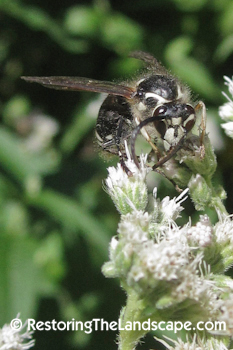
Bald Faced Hornets (Dolichovespula maculata) have been difficult to photograph due to their fast, erratic flight but are regularly visiting Boneset flowers. This photo was taken a couple of years ago.

Wasps play an important role in the wildlife garden, keeping populations of plant damaging insects down and providing a balanced food web.

Wasps are not aggressive when visiting flowers for nectar. Stop and take a closer look at them and appreciate their unique forms and colorations.


Native Plant of the Week: Swamp Milkweed ~ Asclepias incarnata

Swamp Milkweed ~ Asclepias incarnata

Swamp Milkweed was in full bloom last week. I purchased 5 more plants this spring and added them to the rain garden by the driveway. All are doing fantastic, and providing an excellent source of nectar for pollinators.

Swamp Milkweed is a native perennial of wetland edges and moist soils. If you have drier soils, it can be short lived if there are periods of drought. But if you are fortunate to have a low lying area in full sun in your yard (that stays moist), swamp milkweed is an excellent candidate.

The light to dark pink flowers are extremely fragrant, reminding me of a vanilla scent. The leaves are opposite in arrangement, narrow and pointed.

Milkweeds have the most interesting flower form, comprised of horns and hoods, the whole cluster arranged in an umbel. Just take an up close look at the flowers some time to appreciate their form. Seed pods are upright and hold numerous seeds with silky hairs attached, the pods open and the seeds are wind dispersed.

And of course, this is one of several milkweed larval host plants for the Monarch Butterfly.

I've had one plant in particular that the Yellow Faced Bees (Hylaeus spp.) have been coming to. Their small size allows them to dip their heads down into flowers for the nectar rewards.
Close up of the Yellow Faced Bee.

The majority of insect visitors however are wasps. It's a favorite of the Great Black Wasp (Sphex pensylvanicus) in our yard.

As well as Yellow Jackets and ...
Northern Paper Wasps.

Tachinid Flies also take advantage of the abundance of nectar offered.

Also Soldier Beetles.

Swamp Milkweed can also host Aphids. One of the new plants has a good crop of Aphids. Not to worry though, there's plenty of Lady Bird Beetles nearby.

Swamp Milkweed is native to central and eastern North America. See map for range.
Kartesz, J.T., The Biota of North America Program (BONAP).
2011. 
North American Plant Atlas. Chapel Hill, N.C.


A Rain Garden Based Upon Local Examples

I am really pleased with our rain garden by the driveway this year. Five years ago the area was paved and at that time, we removed the asphalt and created a bowled garden with a berm at the back.

The garden is 25 feet long and about 10 feet wide. It collects all the water runoff from our cul de sac.

When I help clients with their landscapes or give talks, I always tell people to become familiar with their local landscape. Take a walk at your local park and make note of what native species are growing where (or in similar conditions in your own yard).

I walked the dog at a local park today where the city has been doing a prairie restoration. Many parts of the prairie are moist, and these low lying areas drain into the local watershed creek.

Joe Pye Weed is growing in large patches in the lower lying portion of the prairie along with Swamp Milkweed, Boneset and Swamp Verbena.

Ironweed in the foreground (just finished flowering) along with Joe Pye Weed and Prairie Cord Grass.

A nice combination of Swamp Verbena, Boneset and Black Eyed Susan.

And a large patch of Cup Plant just off the trail in a moist spot. False Sunflower on the right along with (not shown) Wild Bergamot.

Also along the trail in drier sites is Big Bluestem, Indian Grass and Side Oats Grama.
I have replicated many of these native species from this park into the rain garden. Cup Plant makes a nice backdrop or screen reaching heights of 10 feet. Joe Pye Weed, Boneset and Ironweed were planted where the water drains from the cul de sac. Swamp Milkweed is on the front edge and on the drier back side we planted Big Bluestem and False Sunflower.

Native Plant of the Week: American Spikenard ~ Aralia racemosa

American Spikenard ~ Aralia racemosa

American Spikenard is just finishing flowering in our woodlands. The tiny white flowers are insignificant on their own, but because they are clustered in umbels that make up a branched panicle, the whole panicle can be quite showy.
This is a large herbaceous perennial native, occurring on shaded slopes in mature, mesic woodlands. It can reach 5 or more feet in height. The leaves are compound, and each leaflet is heart-shaped.

Spikenard is a very attractive plant and can be utilized with great effect massed in any woodland garden. It grows well under trees, as a backdrop to shorter woodland perennials or layered with ephemerals that go dormant early - such as Virginia Bluebells.

Other nice attributes of this native include the dark purple stems and bright red (turning to dark purple) fruit.

Many native plant nurseries cultivate this plant, so if you have the right location, there's a good chance you can find a local source.


Kartesz, J.T., The Biota of North America Program (BONAP).
2011. 
North American Plant Atlas. Chapel Hill, N.C.
If you have seen birds or other wildlife feeding on the berries, please post a comment.

American Spikenard is native to eastern North American as well as the southwest states. See map for range.

The Bombus Among Us

The native plants in our landscape attract many different Bumble Bee species. Here are just a few of the species I photographed (and have hopefully correctly identified) in our yard this season.
Black & Gold Bumble Bee
Bombus auricomus

The Black & Gold Bumble Bee (Bombus auricomus) is one of the largest bumble bees we have in the upper midwest. This season, they have been spotted on our Wild Lupine, then Wild Bergamot and now their preferred native plant is Tall Larkspur.

Tricolored Bumble Bee (Bombus ternarius) are much smaller in size, with two distinctive dark orange bands. A similar looking species is Bombus rufocinctus.

The Perplexing Bumble Bee (Bombus perplexus) also likes the Wild Bergamot.
And a possible sighting of the rare Rusty Patched Bumble Bee (Bombus affinis) on Culver's Root. "The rusty-patched bumble bee is an eastern bee whose workers have a small rust-colored patch on the middle of their second abdominal segment. This bee was once commonly distributed throughout the east and upper Midwest of the United States, but has steeply declined in recent years." (The Xerces Society)

Native plants play an important role in helping Bumble Bee populations. Select regionally appropriate native species favored by Bumble Bees, create more Bumble Bee friendly habitat and don't use pesticides in your landscape.

For regionally specific plant lists, visit The Xerces Society website. The Xerces Society also just released this new publication titled Conserving Bumble Bees. Download a copy here:
Conserving Bumble Bees

Native Plant of the Week: Side Oats Grama ~ Bouteloua curtipendula

Side Oats Grama ~ Bouteloua curtipendula
Side Oats Grama is one of my favorite prairie grasses.  The distinctive characteristic of this grass is that the spikes all hang in the same direction from the seed stalk. As the the stalks arch over, each spike dangles down like fish drying on a line.

The bright red anthers are extremely showy. One of the tallest in the Bouteloua genus, Side Oats Grama is a native perennial bunch grass reaching heights to about 30 inches. The 'bunch' of blades stays quite low, below 8 inches.

In a native garden, it is both a nice grass to feature on its own, in a mass or intermixed in an informal planting along with prairie forbs. The long slender seed stalks give it an airy transparent quality.

This native grass likes mesic to dry, well drained soils in full to part sun. Its native habitat includes prairies, woodland openings and gravel slopes.

Side Oats Grama is native to most of North America, see map for range.

Kartesz, J.T., The Biota of North America Program (BONAP).
2011. 
North American Plant Atlas. Chapel Hill, N.C.