Showing posts with label Beetles. Show all posts

Milkweed Pollination - A Sticky Situation

Milkweed plants, Asclepias spp. have a unique method of transferring pollen from one plant to the other for cross-pollination. Pollen is aggregated in sac-like bundles called pollinia, located on either side of the stigmatic chamber. The two bundles are strung together with a gland (filament) at the top of the stigmatic chamber.

Bees, wasps, flies, beetles and butterflies visit the flowers for nectar. Milkweed plants typically produce a lot of nectar, it is replenished overnight, to the delight of nocturnal moths, and the remaining nectar is ready for the first diurnal visitors in the morning.

For accessing nectar, floral visitors prop themselves on one of the five flower hoods, sliding their tongues down the side of the hood where the nectar is held. They must be careful not to slip their leg down into the flower between the anthers.

When pulling their leg out, they could snag it on the filament holding together the sticky pollinia sacs.
Pollina stuck to the legs of a great
black wasp, Sphex pensylvanicus
The sticky pollinium sacs are carried to other milkweed plants on their legs and if the insect again ‘slips’ the pollinia can be inserted into the stigmatic chamber ensuring cross-pollination. Unable to pull their leg out, smaller bees can become trapped in the flowers and perish.

In a study by Fishbein and Venable (1996), small- and medium-sized bees, and medium-sized butterflies had the lowest removal rates of pollinia. Their study found that it was the larger bees, like bumble bees that were most effective at transferring pollinia from one plant to the other.

Leafcutter bee, Megachile sp. alighting
on top of the flower hoods to nectar.
Ivey et al. (2003), also found large carpenter bees, Xylocopa spp. and bumble bees, Bombus spp. effective pollinators, partly due to their foraging efficiency; they visit flowers methodically, probing all the hoods of a flower, and visiting more flowers per flowerhead.


Leafcutter bees are common visitors of milkweed feeding on nectar. They rarely snag pollinium sacs so are considered ineffective pollinators.


Small carpenter bees, Ceratina spp. prop themselves on the top of the hood and slide their tongue down the side of the hood to reach nectar.

Cuckoo bees, Coelioxys spp. are true nectar thieves. The have no pollen-collecting structures on their legs. They only visit flowers for nectar because they are cleptoparasites, laying their eggs in the nests of other bees.

This particular cuckoo bee is a cleptoparasite of leafcutter bees,  Megachile spp. Females have a tapered abdomen ending in a sharp point that is used to break through leafcutter brood cells.

Another example of a small-sized bee, yellow faced bees, Hylaeus spp. are frequent visitors to swamp milkweed in late summer for nectar.

Soldier beetles, Chauliognathus spp. also love to feed on nectar on milkweed plants but are rarely found carrying pollinia.

What seems to be a not-so-mutualistic relationship between floral visitor and plant, where floral visitors are exploiting nectar resources, cross-pollination is still occurring due to the effective visitation by large bees, who transfer the polllinium sacs from one plant to another.


References
Fishbein, M., & Venable, D. L. (1996). Diversity and temporal change in the effective pollinators of Asclepias tuberosa. Ecology, 1061-1073.

Ivey, C. T., Martinez, P., & Wyatt, R. (2003). Variation in pollinator effectiveness in swamp milkweed, Asclepias incarnata (Apocynaceae). American Journal of Botany, 90(2), 214-225.

Kephart, S. R. (1983). The partitioning of pollinators among three species of Asclepias. Ecology, 120-133.


Native Plant of the Week: New England Aster ~ Symphyotrichum novae-angliae

New England Aster ~ Symphyotrichum novae-angliae (Aster novae-angliae)

New England Aster is a wonderful perennial native for late season color. We added some to our landscape last fall and it's flowering for the first time this year.

I associate this Aster with the southern Great Lakes region and northeast, but it does occur here in Minnesota.

Flower color can range from a medium purple/violet to pink. Blooming from late August and sometimes continuing into early November.

I thought I would see more bumble bees visiting the flowers but their preference right now is the Showy Goldenrod in our landscape. One Spotted Cucumber Beetle was crawling on the flower rays.

New England Aster can get extremely tall, especially in moister soils reaching heights over 6 feet, but shorter in sandy, well drained soils.

The leaves are relatively short and narrow, hairy and clasp the flower stem. The stem is also hairy. The lower leaves on a tall cluster of New England Aster will brown out and die off. Plant some medium height prairie grasses around this Aster such as Little Bluestem if you want to hide the unattractive lower stems.

This native perennial is tolerant of partial to full sun, sand to loamy soils. Plant in combination with Showy Goldenrod for an outstanding contrasting color display in the late fall.

Kartesz, J.T., The Biota of North America Program (BONAP).
2011. 
North American Plant Atlas. Chapel Hill, N.C.
New England Aster is native to (mostly) eastern North America. See map for range


Native Plant of the Week: Black-Eyed Susan ~ Rudbeckia hirta

Black-Eyed Susan ~ Rudbeckia hirta

This native perennial (sometimes biennial) deserves a place in any sunny landscape. A very versatile plant, it will grow in dry to wet soils in prairies, roadsides and woodland edges.

The bright yellow-orange flowers open in late June, continuing to flower and often rebloom into the fall months.

The dark brown central disk iscomprised of many florets and is surrounded by 8-21 yellow-orange rays.

The whole flower is two - three inches in width making it extremely showy.
The leaves are very coarse to the touch as they are covered with hairs, along with the flower stalk and flower bracts.

In our landscape, Black-Eyed Susans are short-lived but they do readily reseed themselves so we always have some. If you plan to add this native to your landscape, it  works well to buy seed because Black-Eyed Susans will often flower the same year as seed is sown.

Native bees like this female Long Horned Bee will visit the flower for pollen, along with smaller Sweat Bees.

Insect larvae will feed on the central cone and bore holes in it. Several of the flowers in our landscape will have a single ray floret folded over the top of the cone to create a protected feeding area.

Beetles will also visit the flowers, a Soldier Beetle and Blister Beetle pictured here. Read more about this Blister Beetle's lifecycle here.


Black-Eyed Susans are native to central and eastern North America. See map for range.
Kartesz, J.T., The Biota of North America Program (BONAP).
2011. 
North American Plant Atlas. Chapel Hill, N.C.

Common Boneset: A Five Star Wasp Plant

Northern Paper Wasp
Common Boneset ~ Eupatorium perfoliatum

The Common Boneset is a hive of activity right now. Wasps especially are attracted to the white flowers. I counted seven Northern Paper Wasps on one plant yesterday.

A brand new insect sighting this summer was this male Tiphiid Wasp (Myzinum sp.). The male sports a fake or 'pseudo' stinger that looks very menacing. The larvae of this wasp are parasitoids of scarab beetle larvae (ex. June Beetles). (BugGuide.net)

This Sand Wasp (Bicyrtes sp.) is also most often spotted on Common Boneset. This wasp preys upon true bugs (ex. Shield Bugs).

The distinctively shaped Potter Wasp (Eumenes sp.) also likes Common Boneset.
A Thread Waisted Wasp (Isodontia sp.) that nests in hollow stems and hunts crickets and katydids. (Insects of the North Woods)

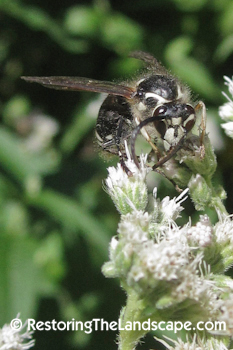
Bald Faced Hornets (Dolichovespula maculata) have been difficult to photograph due to their fast, erratic flight but are regularly visiting Boneset flowers. This photo was taken a couple of years ago.

Wasps play an important role in the wildlife garden, keeping populations of plant damaging insects down and providing a balanced food web.

Wasps are not aggressive when visiting flowers for nectar. Stop and take a closer look at them and appreciate their unique forms and colorations.


Native Plant of the Week: Swamp Milkweed ~ Asclepias incarnata

Swamp Milkweed ~ Asclepias incarnata

Swamp Milkweed was in full bloom last week. I purchased 5 more plants this spring and added them to the rain garden by the driveway. All are doing fantastic, and providing an excellent source of nectar for pollinators.

Swamp Milkweed is a native perennial of wetland edges and moist soils. If you have drier soils, it can be short lived if there are periods of drought. But if you are fortunate to have a low lying area in full sun in your yard (that stays moist), swamp milkweed is an excellent candidate.

The light to dark pink flowers are extremely fragrant, reminding me of a vanilla scent. The leaves are opposite in arrangement, narrow and pointed.

Milkweeds have the most interesting flower form, comprised of horns and hoods, the whole cluster arranged in an umbel. Just take an up close look at the flowers some time to appreciate their form. Seed pods are upright and hold numerous seeds with silky hairs attached, the pods open and the seeds are wind dispersed.

And of course, this is one of several milkweed larval host plants for the Monarch Butterfly.

I've had one plant in particular that the Yellow Faced Bees (Hylaeus spp.) have been coming to. Their small size allows them to dip their heads down into flowers for the nectar rewards.
Close up of the Yellow Faced Bee.

The majority of insect visitors however are wasps. It's a favorite of the Great Black Wasp (Sphex pensylvanicus) in our yard.

As well as Yellow Jackets and ...
Northern Paper Wasps.

Tachinid Flies also take advantage of the abundance of nectar offered.

Also Soldier Beetles.

Swamp Milkweed can also host Aphids. One of the new plants has a good crop of Aphids. Not to worry though, there's plenty of Lady Bird Beetles nearby.

Swamp Milkweed is native to central and eastern North America. See map for range.
Kartesz, J.T., The Biota of North America Program (BONAP).
2011. 
North American Plant Atlas. Chapel Hill, N.C.


Hoary Vervain Insect Visitors

Hoary Vervain ~ Verbena stricta


I planted more Hoary Vervain a few years ago in our landscape because it likes dry, sandy locations in full sun. Now, I'm enjoying a significant increase in the diversity of pollinators and insect visitors coming to Hoary Vervain.

Small Skipper Butterflies like the tubular five-parted flowers. Pictured here, Peck's Skipper (Polites peckius), one of the easier small skippers to identify with its distinct markings.

A second Skipper, my best guess is Fiery Skipper (Hylephila phyleus), although we are a little north of its range. Perhaps due to our early spring warm-up this Skipper got a head start on its migration north and traveled a little further.

Cabbage White butterflies (Pieris rapae) are also frequent visitors seeking out nectar.

Hoary Vervain flowers from the bottom upwards, on the tall narrow flower spike. The flowering time can therefore last from July into September providing a nice source of nectar for insects.
Some of the first Soldier Beetles in our yard this season are on Hoary Vervain. They like to feed on both nectar and pollen on many types of flowers.

Soldier Beetles are predators of other insects and are therefore considered natural enemies. Falling in the family Cantharidae, some soldier beetle adults will feed on aphids, and insects eggs and larvae providing biological control.
(Michigan State University, Natural Enemies)

This attractive, large Syrphid fly was using its long mouthpart to sponge up some nectar.

Syrphid flies are also predators, some larvae feed on aphids.

Bumble Bees also like the Hoary Vervain flowers. Less frequent visitors, probably because some preferred native species such as Wild Bergamot flower at the same time.

These medium-sized fast moving Long Horned Bees (Melissodes species) would stop on the Hoary Vervain just long enough so I could snap a photo.

This particular bee likes to fly around other bees nectaring and take small jabs at them. They seem to spend their time doing this more than landing on flowers for pollen or nectar.
Two of the new bee species discoveries this season have occurred on Hoary Vervain.

This Cuckoo Leafcutting Bee (Coelioxys species) is a cleptoparasite of Leafcutter Bees. With no means to collect pollen, its only visiting the Hoary Vervain for nectar. Read more about the Cuckoo Leafcutting Bee here: Another New Native Bee Discovery.

The second discovery, just last week was another Cuckoo (cleptoparasitic) Bee in the Genus Triepeolus. With bright orange legs and black and white striped body, it is an extremely attractive bee.

These bees lay their eggs in the nests of Long-Horned Bees (Melissodes species).

If you have an open, sunny location with medium to dry soils, I highly recommend Hoary Vervain. Its upright stature, coarse leaves and long blooming purple flowers make it a great addition to any landscape or prairie.


Native Plant of the Week: Nodding Onion ~ Allium cernuum

Nodding Onion ~ Allium cernuum


With our ongoing drought in many parts of the continent, it's a good idea to investigate what native plants are thriving in this heat. Nodding Onion is one of these natives, loving hot, sunny locations in dry sandy soils. It is also apparently tolerant of loam or clay soils.

Very similar to Prairie Onion (Allium stellatum), Nodding Onion has drooping umbel flowerheads comprised of 6 parted light pink flowers. Flower stalk heights range from 12 -24 inches.

The basal leaves are linear and grass-like in appearance, and often go unnoticed because the foliage of neighboring plants will hide the onion leaves.

The leaves have an onion odor, not as strong as chives but quite apparent. Nodding onion works really well intermixed with shorter prairie natives at the edge of a planting. It looks fantastic planted with Wild Petunia, Side Oats Grama and Spotted Beebalm all of which flower at the same time.

The primary visitor to the tiny flowers are small Halictid bees. Look for them clinging to the underside of the nodding flowers.

The occasional Leafcutter Bee will also visit the flowers of the Nodding Onion in our yard.

And where the bees visit, you will often find Tumbling Flower Beetles feeding on pollen.
I also spotted the Weevil species this morning. I'm going to investigate later if the weevil is feeding on any part of the Nodding Onion plant.

Nodding Onion is native to many parts of North America, see map below for range.

Kartesz, J.T., The Biota of North America Program (BONAP).
2011. 
North American Plant Atlas. Chapel Hill, N.C.