Showing posts with label Wasps. Show all posts

Predator Profile ~ Grass Carrying Wasps, Isodontia spp.

Grass-Carrying Wasps ~ Isodontia spp. 

There are a number of ways to attract beneficial insects to your landscape. Planting a diversity of native plants is an easy, win-win solution. Not only do the plants attract many types of beneficial insects including solitary wasps, but they help support a functioning, complex ecosystem.

One of the most interesting solitary wasps in my landscape is the grass carrying wasp. Several years ago I purchased a bell-shaped wire frame. I filled the openings with hollow stems from native perennials in my yard to see what types of solitary bees would use the cavities. I was surprised to find that the primary insect that uses these cavities is the grass carrying wasp, a welcome resident.

Grass-carrying wasps are predators of crickets and katydids. Females sting their prey in the head or thorax which causes paralysis. The immobile prey is carried back to the nest located in cavities in hollow stems, holes bored in wood or openings in rocks. Prey, alive but immobile is stocked in the nest. When enough prey is cached the female wasp lays an egg in the cavity near the prey. Prey becomes food for the developing wasp larvae to feed upon. Females collect grass pieces carrying strands clasped in their mandibles. In my landscape, I have observed them picking up pieces of little bluestem, Schizachyrium scoparium grass blades.

Little bluestem on my 'prairie' slope.
Grass-carrying wasps use the grass blades in their nests.
They use these pieces of grass to divide their nesting cavity into sections as well as close the cavity. Look for pieces of grass stuffed into the ends of the board holes.

Grass carrying wasps are medium-sized thread-waisted wasps with a black head, thorax and abdomen. Their wings are medium to light brown. Similar to the majority of solitary wasps they are very docile and not aggressive towards humans - even near their nest.

These wasps visit a number of native perennials to feed on nectar. They perennials include common boneset, Eupatorium perfoliatum, pale Indian plantain, Arnoglossum atriplicifolium, rattlesnake master, Eryngium yuccifolium, stiff goldenrod, Solidago rigida and mountain mint, Pycnanthemum virginianum.

Remember to leave plant stems and grass blades standing throughout the winter and into late spring. Insects are using the stems as overwintering sites and inside the cavities could be pupae of solitary bees and beneficial insects. Carefully cut the stems in large pieces and lay them on the ground to allow insects to emerge. Grass blades left on the ground once cut will be used by birds as nesting materials or by these grass carrying wasps.


Beneficial Insects - Predators

Beneficial insects (natural enemies) are predators and parasitoids; they maintain the checks and balances of the insect world, helping to prevent pest populations from getting out of control and causing damage to crops and garden plants. Many of these beneficial insects rely on floral rewards (pollen and nectar) for food so they can be fostered and attracted with a healthy, diverse native planting.

Ladybird Beetle Larva
Feeding on an Aphid
These predators and parasitoids hunt and feed on prey in either or both the adult and larval forms. Soldier beetles, lady bird beetles, syrphid flies, solitary wasps, crab spiders and minute pirate bugs are some important beneficial insects.

The abundance and diversity of beneficial insects in a particular landscape depends on: 
  • the diversity of the landscape
  • the quality and abundance of forage plants 
  • the availability of prey
  • the number and quality of nesting sites
  • the overall health of the plant community 
Native plants play a key role in attracting beneficial insects (and more pollinators). Beneficial insects feed on floral resources and seek shelter in the foliage when not hunting or parasitizing prey. A stressed plant, including one poorly situated, is more susceptible to pests. When selecting plants, make sure to match the site with the habitat where the native plant occurs naturally.

Predators 
Predators feed on insects as adults and/or as larvae. Solitary wasps are excellent predators of large prey; prey, once caught, are cached in the nest live for the hatched larvae to feed on and fuel development. They help control caterpillars, sawfly larvae, katydids, crickets, and grasshoppers - all insects that feed on foliage.

Predator Profile - Great Golden Digger Wasp, Sphex ichneumoneus
Nest Excavation - The female excavates clumps of soil and
holding the clumps between her mandibles
and forelegs, backs out of the nest and deposits
the soil away from the nest entrance. 
Great golden digger wasps are solitary wasps that nest in the ground. These large, brightly colored wasps are prey on crickets and katydids.

Nests are excavated in sand or gravelly soil. Females can be observed excavating nests in mid-summer, pictured on the left excavating a nest in mid-July this year.

Females paralyze prey and fly it back to the nest grasping the prey with their legs and holding it underneath them (left). The wasp places the prey on the ground near the nest entrance. She then checks the nest before placing the prey inside. Females often drag the prey backwards into the nest hole grasping it with her mandibles. Once the prey is cached, a single egg is laid on each cricket/katydid. When the larva hatches, it begins feeding on the prey until pupation.

These wasps are common in late summer and visit a variety of native plants that offer nectar like culver’s root, (Veronicastrum virginicum), rattlesnake master (Eryngium yuccifolium),  purple prairie clover (Dalea purpurea) and spotted beebalm (Monarda punctata) (left).

Providing native plants for nectar foraging helps support these solitary wasps and fuel their hunting activities. A diverse native plant community also provides cover for their prey.


Predator Profile - Syrphid Flies, Family Syrphidae
Syrphid flies are active from spring through late fall and visit a large variety of native plants where they can access floral resources, typically in less complex flower forms.

Adult syrphid flies visit flowers to feed on both pollen and nectar. Females foraging for pollen often hold the flower's anthers with their forelegs while they sponge up the protein-rich pollen with their mouthparts.

Many syrphid flies are excellent mimics and are often mistaken for bees or wasps as their coloration and behavior mimics bees and wasps (left). This mimicry helps protect them from predation by birds and other predators.

Larvae look like small caterpillars and feed on aphids or other small, soft-bodied insects (left). Look for the larvae on the underside of leaves where there is a large aphid population. They often feed on aphids that are much larger than themselves.

Pesticides have a serious impact on beneficial insect (and pollinator) populations. If insecticides are applied to control a problem pest, the beneficial insect population is eliminated at the same time. It often takes less time for the pest population to recover from an application than it does for the beneficial insect populations to recover. Continous pesticide use can result in the ongoing imbalance of pest and beneficial insect populations.

Milkweed Pollination - A Sticky Situation

Milkweed plants, Asclepias spp. have a unique method of transferring pollen from one plant to the other for cross-pollination. Pollen is aggregated in sac-like bundles called pollinia, located on either side of the stigmatic chamber. The two bundles are strung together with a gland (filament) at the top of the stigmatic chamber.

Bees, wasps, flies, beetles and butterflies visit the flowers for nectar. Milkweed plants typically produce a lot of nectar, it is replenished overnight, to the delight of nocturnal moths, and the remaining nectar is ready for the first diurnal visitors in the morning.

For accessing nectar, floral visitors prop themselves on one of the five flower hoods, sliding their tongues down the side of the hood where the nectar is held. They must be careful not to slip their leg down into the flower between the anthers.

When pulling their leg out, they could snag it on the filament holding together the sticky pollinia sacs.
Pollina stuck to the legs of a great
black wasp, Sphex pensylvanicus
The sticky pollinium sacs are carried to other milkweed plants on their legs and if the insect again ‘slips’ the pollinia can be inserted into the stigmatic chamber ensuring cross-pollination. Unable to pull their leg out, smaller bees can become trapped in the flowers and perish.

In a study by Fishbein and Venable (1996), small- and medium-sized bees, and medium-sized butterflies had the lowest removal rates of pollinia. Their study found that it was the larger bees, like bumble bees that were most effective at transferring pollinia from one plant to the other.

Leafcutter bee, Megachile sp. alighting
on top of the flower hoods to nectar.
Ivey et al. (2003), also found large carpenter bees, Xylocopa spp. and bumble bees, Bombus spp. effective pollinators, partly due to their foraging efficiency; they visit flowers methodically, probing all the hoods of a flower, and visiting more flowers per flowerhead.


Leafcutter bees are common visitors of milkweed feeding on nectar. They rarely snag pollinium sacs so are considered ineffective pollinators.


Small carpenter bees, Ceratina spp. prop themselves on the top of the hood and slide their tongue down the side of the hood to reach nectar.

Cuckoo bees, Coelioxys spp. are true nectar thieves. The have no pollen-collecting structures on their legs. They only visit flowers for nectar because they are cleptoparasites, laying their eggs in the nests of other bees.

This particular cuckoo bee is a cleptoparasite of leafcutter bees,  Megachile spp. Females have a tapered abdomen ending in a sharp point that is used to break through leafcutter brood cells.

Another example of a small-sized bee, yellow faced bees, Hylaeus spp. are frequent visitors to swamp milkweed in late summer for nectar.

Soldier beetles, Chauliognathus spp. also love to feed on nectar on milkweed plants but are rarely found carrying pollinia.

What seems to be a not-so-mutualistic relationship between floral visitor and plant, where floral visitors are exploiting nectar resources, cross-pollination is still occurring due to the effective visitation by large bees, who transfer the polllinium sacs from one plant to another.


References
Fishbein, M., & Venable, D. L. (1996). Diversity and temporal change in the effective pollinators of Asclepias tuberosa. Ecology, 1061-1073.

Ivey, C. T., Martinez, P., & Wyatt, R. (2003). Variation in pollinator effectiveness in swamp milkweed, Asclepias incarnata (Apocynaceae). American Journal of Botany, 90(2), 214-225.

Kephart, S. R. (1983). The partitioning of pollinators among three species of Asclepias. Ecology, 120-133.


Grass-carrying Wasps ~ Isodontia spp.

Grass-carrying Wasps ~ Isodontia spp. 

Grass-carrying wasps are a flower-visiting solitary wasp, common in late summer and early fall. Because they are solitary-nesting, and not colonial like yellowjackets or hornets, they do not sting humans to defend their nests. It's an important distinction to make with wasps in our landscapes, so many are solitary and not aggressive.

They perform important ecosystem services, pollinating the plants in our landscape, and preying on foliage eating insects, crickets and katydids in particular.

Females look for prey, stinging them several times to paralyze and immobilize them. They carry their prey back to their nests, which are preexisting cavities such as hollow stems or holes bored in wood.

The paralyzed prey are stocked for their developing larvae to feed upon. Using nearby grasses, nests are divided into sections with pieces of grass, they also close the end of nest with grass.

If you erect a mason bee nest board (board with nesting holes drilled in it), grass-carrying wasps will sometimes build nests in the cavities. Look for pieces of grass sticking out the ends of the board holes or plant stems.

I have several different variations of stem nests hung in the yard for solitary bees (and wasps), this one in particular has been utilized almost exclusively by grass-carrying wasps. Cup plant and pale Indian plantain stems work extremely well, both are hollow.

Here's a cross-section of one of those stems with the wasp larvae and stocked prey. In my yard, the grass-carrying wasps like to use little bluestem to seal off the cavities.

Look for grass-carrying wasps in late summer. In my yard, they like to visit stiff goldenrod, common boneset and pale Indian plantain flowers for nectar.


Wasps in the Wildlife Garden

Did you know that most wasps are solitary nesting and don't sting humans?

There are some fascinating wasp species that visit our garden plants for nectar, and use our landscape to hunt for food for their young including caterpillars, sawfly larvae, crickets and katydids.

Find out more about the behavior and lifecycles of some of the wasps who share our landscape with us on my post this week at Native Plants Wildlife Gardens.

Common Boneset: A Five Star Wasp Plant

Northern Paper Wasp
Common Boneset ~ Eupatorium perfoliatum

The Common Boneset is a hive of activity right now. Wasps especially are attracted to the white flowers. I counted seven Northern Paper Wasps on one plant yesterday.

A brand new insect sighting this summer was this male Tiphiid Wasp (Myzinum sp.). The male sports a fake or 'pseudo' stinger that looks very menacing. The larvae of this wasp are parasitoids of scarab beetle larvae (ex. June Beetles). (BugGuide.net)

This Sand Wasp (Bicyrtes sp.) is also most often spotted on Common Boneset. This wasp preys upon true bugs (ex. Shield Bugs).

The distinctively shaped Potter Wasp (Eumenes sp.) also likes Common Boneset.
A Thread Waisted Wasp (Isodontia sp.) that nests in hollow stems and hunts crickets and katydids. (Insects of the North Woods)

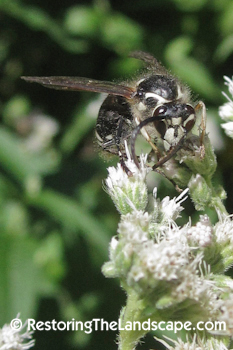
Bald Faced Hornets (Dolichovespula maculata) have been difficult to photograph due to their fast, erratic flight but are regularly visiting Boneset flowers. This photo was taken a couple of years ago.

Wasps play an important role in the wildlife garden, keeping populations of plant damaging insects down and providing a balanced food web.

Wasps are not aggressive when visiting flowers for nectar. Stop and take a closer look at them and appreciate their unique forms and colorations.


Native Plant of the Week: Swamp Milkweed ~ Asclepias incarnata

Swamp Milkweed ~ Asclepias incarnata

Swamp Milkweed was in full bloom last week. I purchased 5 more plants this spring and added them to the rain garden by the driveway. All are doing fantastic, and providing an excellent source of nectar for pollinators.

Swamp Milkweed is a native perennial of wetland edges and moist soils. If you have drier soils, it can be short lived if there are periods of drought. But if you are fortunate to have a low lying area in full sun in your yard (that stays moist), swamp milkweed is an excellent candidate.

The light to dark pink flowers are extremely fragrant, reminding me of a vanilla scent. The leaves are opposite in arrangement, narrow and pointed.

Milkweeds have the most interesting flower form, comprised of horns and hoods, the whole cluster arranged in an umbel. Just take an up close look at the flowers some time to appreciate their form. Seed pods are upright and hold numerous seeds with silky hairs attached, the pods open and the seeds are wind dispersed.

And of course, this is one of several milkweed larval host plants for the Monarch Butterfly.

I've had one plant in particular that the Yellow Faced Bees (Hylaeus spp.) have been coming to. Their small size allows them to dip their heads down into flowers for the nectar rewards.
Close up of the Yellow Faced Bee.

The majority of insect visitors however are wasps. It's a favorite of the Great Black Wasp (Sphex pensylvanicus) in our yard.

As well as Yellow Jackets and ...
Northern Paper Wasps.

Tachinid Flies also take advantage of the abundance of nectar offered.

Also Soldier Beetles.

Swamp Milkweed can also host Aphids. One of the new plants has a good crop of Aphids. Not to worry though, there's plenty of Lady Bird Beetles nearby.

Swamp Milkweed is native to central and eastern North America. See map for range.
Kartesz, J.T., The Biota of North America Program (BONAP).
2011. 
North American Plant Atlas. Chapel Hill, N.C.


Native Plant of the Week: Common Boneset ~ Eupatorium perfoliatum

Common Boneset ~ Eupatorium perfoliatum


Common Boneset is a wonderful native perennial for sandy, moist soils. Flowering a little earlier this year (like almost everything else), Boneset is a four foot tall, upright plant with hairy leaves and stem.


The leaves surround the flower stem and are held outwards horizontally. In our landscape, they make a nice perch for tree frogs watching the visiting insects above on the flowers.

Common Boneset is found along shores in moist soils as well as low lying wet areas in prairies in full sun. It's a good candidate for rain gardens near the input where there's adequate moisture during rain events.

The white flowers are numerous and packed into a somewhat flat flower head. They don't seem to be as attractive to butterflies, but many wasp, bee and fly species will cover the flowers.

These Tachinid flies with their long hairs protruding from the top of their abdomens love Common Boneset and Culver's Root.

Tiny Yellow-Faced Bees (Hylaeus species) visit the flowers regularly.
Both the large Northern Paper Wasps and Bald Faced Hornets also seek out nectar from the flowers.

I have photographed this handsome Sand Wasp (Bicyrtes species) two years in a row on Common Boneset. These wasps fashion their ground nests (in sand) with true bugs such as Stink Bugs for their developing larvae to feed upon. (Source: Bug Eric Blog)

Kartesz, J.T., The Biota of North America Program (BONAP).
2011. 
North American Plant Atlas. Chapel Hill, N.C.


Common Boneset is native to eastern North America. See map for range.