Yellow Faced Bees ~ Hylaeus spp.
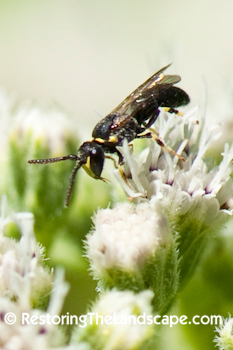
Yellow Faced Bees are tiny black bees with yellow (sometimes white) markings on their face, thorax and legs. Often mistaken for tiny solitary wasps, these bees have quite shiny bodies due to the lack of hairs.
Occurring from late May through to September, we will see Yellow Faced Bees in early spring, then again in late summer with a gap in between.
Some of the first native plants to look for Yellow Faced Bees in spring are Golden Alexanders (Zizia spp.). This female is feeding on pollen of Golden Alexander. Yellow Faced Bees are different from other native bees because they collect pollen and nectar in their crop. They have no pollen-collecting combs on their legs or abdomens.
Pollen is brushed with their forelegs from their head and thorax and then collected in the mouth.
Females collect pollen and nectar, and regurgitate the liquid mixture to provision the brood cells. An egg is laid on top of the mixture where the larva will hatch and consume the liquid.
Yellow Faced Bees nest in cavities, tunnels in pithy wood, or even holes in wood. Their brood cells are separated with a cellophane like material.
A Yellow Faced Bee visiting Canada Anemone (Anemone canadensis) for pollen in early spring.
In late summer look for Yellow Faced Bees nectaring on Swamp Milkweed (Asclepias incarnata). I had several dozen visiting just one plant this summer.
Although Yellow Faced Bees are short-tongued, their small size allows them access to the nectar of many flowers.
They also visit Common Boneset (Eupatorium perfoliatum) in late summer.
Source: Attracting Native Pollinators: The Xerces Society Guide, Protecting North America's Bees and Butterflies
Pollinators | Beneficial Insects | Landscape Restoration | Native Plants | Wildlife |
Showing posts with label Yellow Faced Bees. Show all posts
Native Plant of the Week: Swamp Milkweed ~ Asclepias incarnata
Swamp Milkweed ~ Asclepias incarnata
Swamp Milkweed was in full bloom last week. I purchased 5 more plants this spring and added them to the rain garden by the driveway. All are doing fantastic, and providing an excellent source of nectar for pollinators.
Swamp Milkweed is a native perennial of wetland edges and moist soils. If you have drier soils, it can be short lived if there are periods of drought. But if you are fortunate to have a low lying area in full sun in your yard (that stays moist), swamp milkweed is an excellent candidate.
The light to dark pink flowers are extremely fragrant, reminding me of a vanilla scent. The leaves are opposite in arrangement, narrow and pointed.
Milkweeds have the most interesting flower form, comprised of horns and hoods, the whole cluster arranged in an umbel. Just take an up close look at the flowers some time to appreciate their form. Seed pods are upright and hold numerous seeds with silky hairs attached, the pods open and the seeds are wind dispersed.
And of course, this is one of several milkweed larval host plants for the Monarch Butterfly.
I've had one plant in particular that the Yellow Faced Bees (Hylaeus spp.) have been coming to. Their small size allows them to dip their heads down into flowers for the nectar rewards.
Close up of the Yellow Faced Bee.
The majority of insect visitors however are wasps. It's a favorite of the Great Black Wasp (Sphex pensylvanicus) in our yard.
As well as Yellow Jackets and ...
Northern Paper Wasps.
Tachinid Flies also take advantage of the abundance of nectar offered.
Also Soldier Beetles.
Swamp Milkweed can also host Aphids. One of the new plants has a good crop of Aphids. Not to worry though, there's plenty of Lady Bird Beetles nearby.
Swamp Milkweed is native to central and eastern North America. See map for range.
Swamp Milkweed was in full bloom last week. I purchased 5 more plants this spring and added them to the rain garden by the driveway. All are doing fantastic, and providing an excellent source of nectar for pollinators.
Swamp Milkweed is a native perennial of wetland edges and moist soils. If you have drier soils, it can be short lived if there are periods of drought. But if you are fortunate to have a low lying area in full sun in your yard (that stays moist), swamp milkweed is an excellent candidate.
The light to dark pink flowers are extremely fragrant, reminding me of a vanilla scent. The leaves are opposite in arrangement, narrow and pointed.
Milkweeds have the most interesting flower form, comprised of horns and hoods, the whole cluster arranged in an umbel. Just take an up close look at the flowers some time to appreciate their form. Seed pods are upright and hold numerous seeds with silky hairs attached, the pods open and the seeds are wind dispersed.
And of course, this is one of several milkweed larval host plants for the Monarch Butterfly.
I've had one plant in particular that the Yellow Faced Bees (Hylaeus spp.) have been coming to. Their small size allows them to dip their heads down into flowers for the nectar rewards.
Close up of the Yellow Faced Bee.
The majority of insect visitors however are wasps. It's a favorite of the Great Black Wasp (Sphex pensylvanicus) in our yard.
As well as Yellow Jackets and ...
Northern Paper Wasps.
Tachinid Flies also take advantage of the abundance of nectar offered.
Also Soldier Beetles.
Swamp Milkweed can also host Aphids. One of the new plants has a good crop of Aphids. Not to worry though, there's plenty of Lady Bird Beetles nearby.
Swamp Milkweed is native to central and eastern North America. See map for range.
![]() |
| Kartesz, J.T., The Biota of North America Program (BONAP). 2011. North American Plant Atlas. Chapel Hill, N.C. |
Subscribe to:
Posts (Atom)


