Showing posts with label Clearwing Moth. Show all posts

Wild Lupine Insect Visitors

Wild Lupine ~ Lupinus perennis 

Wild Lupine is a native perennial of dry, sandy sites in full sun. Flowering from late April/early May into June, the flower color ranges from light blue to dark purple.


Because of its early flowering time, overwintering queen Bumble Bees or their female offspring will visit the flowers. The irregular flower form means that the larger Bumble Bees don't have too much difficulty prying open the lower wing petals to reveal the reward inside.

Bombus auricomis


According to Illinois Wildflowers, there is no nectar reward provided by Wild Lupine, and pollen is forcibly ejected into the faces of bees.

Butterflies and moths will visit the flowers looking for nectar but come away with no reward. I photographed this Hummingbird Clearwing Moth this spring on our Wild Lupine flowers.

I also observed many Mason Bees (Osmia spp.) visiting Wild Lupine flowers this spring. They start with their rear legs prying open the petals, get a start on it opening, then use their mid and forelegs to hold the flowers open.

Wild Lupine and Mason Bees were built for each other, as Mason Bees collect pollen on their abdomens. Perfect for where the fused stamens are located just above the bottom keel, rubbing off some pollen for cross-pollination onto the Mason Bee abdomen.

Look for Mining Bees (Andrena spp.) a ground nesting native bee that emerges in early spring and visits flowers to collect pollen and nectar for nest provisioning.

Small Carpenter Bees (Ceratina spp.) also look in vain for nectar on flowers that have been forced open and are accessible as they cannot pry open the petals themselves.

Wild Lupine is a larval host plant to several butterfly and moth species, the most notable is the specialist Karner Blue Butterfly (Lycaeides melissa) an endangered butterfly.


Native Plant of the Week: Wild Lupine ~ Lupinus perennis

Wild Lupine ~ Lupinus perennis


Wild Lupine is in full bloom in our yard right now. This native Lupine is smaller than the non-native, naturalized Large-Leaved Lupine (Lupinus polyphyllus), reaching heights of around 14 inches in our dry, sandy soil.

The palmately divided leaves are very attractive in their own right, offering a wonderful contrast to other native perennial foliage.

This is a great native for hot, dry sites and poor soils. Plant near the front or edge of your landscape so you can observe and enjoy all the different types of pollinators that visit the flowers.
Two species of Bumble Bees were visiting the flowers this week. Their large size makes nectaring on the flower a bit challenging, but their advantage over the smaller bees is they can easily pry apart the petals to reach inside the flowers.

The smaller Mason Bees (Osmia species) pry open the flowers with their rear legs, then use all six to keep it open so they can reach further inside the flower.

Mining Bees (Andrena species) also like visiting Wild Lupine flowers.
I also spotted a day flying Clearwing moth visiting the flowers. They will hover like Hummingbirds unfurling their long proboscis and inserting it into the flowers. With this sophisticated technique, there's no need for them to pry open the flowers.

Seeds form in hairy pods that are held upright on the stem. This is an easy plant to propagate from seed, cold stratify in moist sand in the fridge over the winter and scarify (scratch) the seed coat before planting in the spring.

Kartesz, J.T., The Biota of North America Program (BONAP).
2011. 
North American Plant Atlas. Chapel Hill, N.C.
Wild Lupine is native to eastern North America. See map for range.

Native Plant of the Week: Wild Bergamot ~ Monarda fistulosa

Wild Bergamot ~ Monarda fistulosa
Other Common Name: Wild Beebalm

Wild bergamot is a great native perennial plant that thrives in full to part sun. The light pink tubular flowers are arranged in clusters at the top of the stem. The fragrant gray-green leaves are opposite on the square stems.

This native flowers from late June to early August in Minnesota. The flowers are nectared upon by many types of insects, especially those with long 'tongues', as well as hummingbirds.

Day flying moths will nectar on Wild Bergamot. This photo shows the Hummingbird Clearwing Moth (Hemaris thysbe) nectaring. I have also seen the Snowberry Clearwing Moth on the Wild Bergamot.

Read an earlier post here on these moths.

Many types of butterflies like Wild Bergamot, we will often have several Monarch Butterflies on our Bergamot. Skippers and swallowtails also like to nectar on this native.

Wild bergamot is a larval host for one of our local moths, the Hermit Sphinx moth (Lintneria eremitus). The Hermit Sphinx moth caterpillars feed at night and will hide during the day near the base of the foodplant. (Moths & Caterpillars of the North Woods)

Also look for several types of bees on the Wild Bergamot.
Wild Bergamot was used extensively by Native Americans for many purposes. One of the most well known is the use of the leaves as a tea.

Other enthobotanic uses included culinary and medicinal uses. Read more about these on the USDA Plants Database Fact Sheet.


In the late fall the seed will be sought out by chickadees and sparrows. The dried round seedheads are an attractive feature in the garden alongside prairie grasses that are turning their golden hues in the fall.

Wild Bergamot is native to most of North America except California, Florida and the Atlantic provinces. The similar east coast native Monarda didyma has been cultivated by the horticultural industry as an ornamental. The other common Monarda species in our area is Monarda fistulosa (Spotted Beebalm). Read an earlier post about this plant.

Snowberry Clearwing Moth & Native Foodplants

Snowberry Clearwing Moth ~ Hemaris diffinis
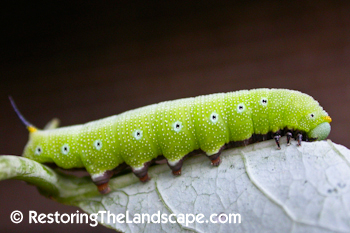
If you want to attract this amazing day flying nectaring moth, having the right native food and nectar plants in your yard is the key. This caterpillar was photographed in early June.

Hemaris thysbe in flight


Pictured here is the closely related species, Hummingbird Clearwing Moth (Hemaris thysbe), with its long proboscis unfurling from its coil to nectar on native Bergamot (Monarda fistulosa).


Hemaris diffinis
Clearwing moths are fun to watch as they hover like hummingbirds nectaring on flowers.

These moths are bee mimics, resembling a bumble bee. Read an earlier post on bee mimics here.This defensive camouflage makes birds think twice about eating the moth, a real advantage since they're active during the day.

This moth has "two overlapping generations" per year in the upper Midwest. (Moths & Caterpillars of the North Woods) "When they (caterpillars) are fully-grown they drop to the ground, spin a loose cocoon and pupate, partially protected by leaf litter." (US Forest Service, Celebrating Wildflowers)


MAJOR NATIVE FOODPLANTS 
FOR SNOWBERRY CLEARWING MOTHS
The Snowberry Clearwing Moth caterpillars have some favorite food plants including Diervilla ~ Bush Honeysuckle, Lonicera ~ Honeysuckles, Symphoricarpos ~ Snowberry, Amsonia ~ Bluestar, and Apocynaceae ~ Dogbane. (Caterpillars of Eastern North America)

Bush honeysuckle ~ Diervilla lonicera is a great native shrub for medium to dry shade. It has a layering habit and in the home landscape works well planted under mature trees. The new leaf growth is burgundy tinged, and the yellow flowers emerge mid June.

Snowberry ~ Symphoricarpos albus is a nice native shrub for full sun or partial shade. It has a blue green opposite leaves, and small pinkish-white flowers in July that produce small white berries in late fall. It also has a suckering habit, forming thickets and is another good candidate for under trees when there is adequate sunlight.
Eastern Bluestar ~ Amsonia tabernaemontana is one of many native Amsonia species that flowers in May, five petaled, light blue flowers. This is a very drought tolerant native for full sun and well drained soils. Note: there are no Amsonia species native to Minnesota.

The attractive foliage turns a golden yellow in fall with interesting partially hidden seed pods that unwrap to reveal a rectangular brown seed.


Hemp Dogbane ~ Apocynum cannabinum is one of several native Dogbane species. It is often mistaken for Milkweed species because of its milky sap. Dogbane flowers from late June through July. It grows in open, sunny and often disturbed habitats.
It is an aggressive native and for that reason is not usually available for sale.