Showing posts with label Sand Wasp. Show all posts

Common Boneset: A Five Star Wasp Plant

Northern Paper Wasp
Common Boneset ~ Eupatorium perfoliatum

The Common Boneset is a hive of activity right now. Wasps especially are attracted to the white flowers. I counted seven Northern Paper Wasps on one plant yesterday.

A brand new insect sighting this summer was this male Tiphiid Wasp (Myzinum sp.). The male sports a fake or 'pseudo' stinger that looks very menacing. The larvae of this wasp are parasitoids of scarab beetle larvae (ex. June Beetles). (BugGuide.net)

This Sand Wasp (Bicyrtes sp.) is also most often spotted on Common Boneset. This wasp preys upon true bugs (ex. Shield Bugs).

The distinctively shaped Potter Wasp (Eumenes sp.) also likes Common Boneset.
A Thread Waisted Wasp (Isodontia sp.) that nests in hollow stems and hunts crickets and katydids. (Insects of the North Woods)

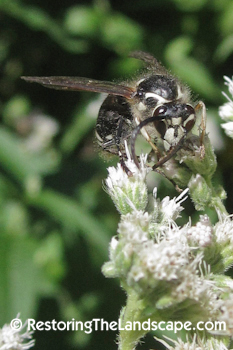
Bald Faced Hornets (Dolichovespula maculata) have been difficult to photograph due to their fast, erratic flight but are regularly visiting Boneset flowers. This photo was taken a couple of years ago.

Wasps play an important role in the wildlife garden, keeping populations of plant damaging insects down and providing a balanced food web.

Wasps are not aggressive when visiting flowers for nectar. Stop and take a closer look at them and appreciate their unique forms and colorations.


Native Plant of the Week: Common Boneset ~ Eupatorium perfoliatum

Common Boneset ~ Eupatorium perfoliatum


Common Boneset is a wonderful native perennial for sandy, moist soils. Flowering a little earlier this year (like almost everything else), Boneset is a four foot tall, upright plant with hairy leaves and stem.


The leaves surround the flower stem and are held outwards horizontally. In our landscape, they make a nice perch for tree frogs watching the visiting insects above on the flowers.

Common Boneset is found along shores in moist soils as well as low lying wet areas in prairies in full sun. It's a good candidate for rain gardens near the input where there's adequate moisture during rain events.

The white flowers are numerous and packed into a somewhat flat flower head. They don't seem to be as attractive to butterflies, but many wasp, bee and fly species will cover the flowers.

These Tachinid flies with their long hairs protruding from the top of their abdomens love Common Boneset and Culver's Root.

Tiny Yellow-Faced Bees (Hylaeus species) visit the flowers regularly.
Both the large Northern Paper Wasps and Bald Faced Hornets also seek out nectar from the flowers.

I have photographed this handsome Sand Wasp (Bicyrtes species) two years in a row on Common Boneset. These wasps fashion their ground nests (in sand) with true bugs such as Stink Bugs for their developing larvae to feed upon. (Source: Bug Eric Blog)

Kartesz, J.T., The Biota of North America Program (BONAP).
2011. 
North American Plant Atlas. Chapel Hill, N.C.


Common Boneset is native to eastern North America. See map for range.

A New Sand Wasp Visitor

Sand Wasp
Bicyrtes quadrifasciatus

Late summer is the time of year to observe a large diversity of insects in our landscape. We've had a few new wasps appear this week, one in particular was interesting - a type of Sand Wasp in the family Crabronidae. These wasps were nectaring on Boneset (Eupatorium perfoliatum) in our raingarden.

Its longer than typical body is black with white stripes and is very similar in shape to the Cicada Killer Wasp.

The majority of sand or digger wasps are ground nesting wasps, although some nest in dead wood or mud nests. They are solitary nesters, but some species will build nests in the same area. These wasps are predators on a variety of other insects including flies, bugs and bees where they fly the prey back to their nests in their mandibles. (Insects Their Natural History and Diversity)

This particular genus of Sand Wasp likes to provision its nest with true bugs, the nest is mass provisioned once, then closed. (BugGuide.net) It is important to leave some bare areas of soil in your landscape, especially sandy soil for these wasps. Many native wasp and bee species nest in the ground.

Have you seen Sand Wasps in your landscape?